
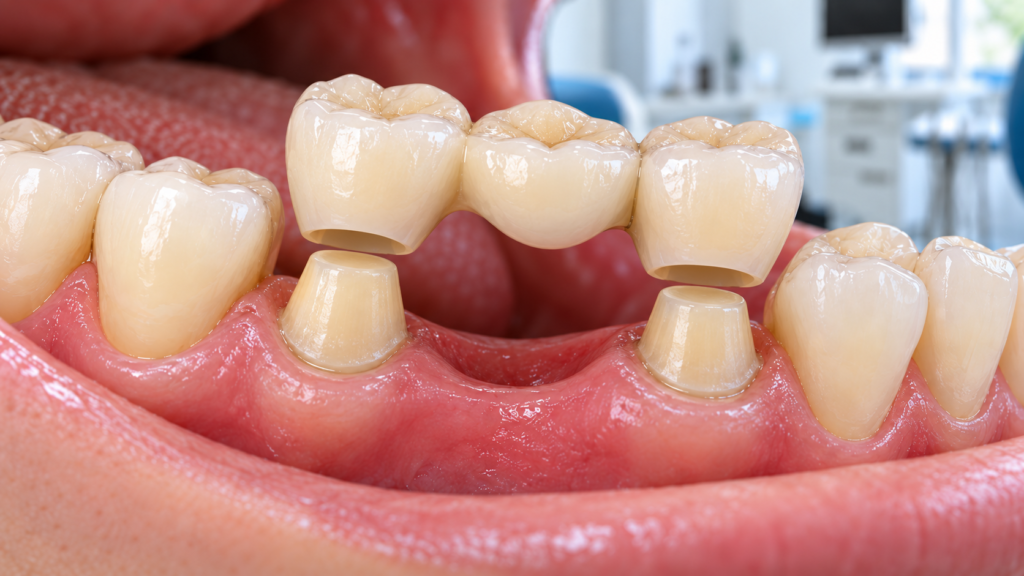
Dental Bridges in Long Beach, CA: Replace Missing Teeth with a Natural-Looking, Fixed Solution
A missing tooth leaves more than a gap in your smile. Over time, the teeth next to it can shift, your bite can change, and chewing can become harder. A dental bridge fills that gap with a natural-looking replacement tooth that stays securely in place. At Salem Dentistry in Long Beach, Dr. Roxana Salem, DDS, designs each bridge to match your smile and restore comfortable chewing.
Call 562-435-8339 or book online
Why patients choose Salem Dentistry for bridges
- One dentist from start to finish. You see Dr. Salem at every visit, from planning to final placement.
- Advanced training. Dr. Salem completed the Comprehensive Esthetic & Restorative Residency at the Esthetic Professionals Dental Educational Center (2016–17).
- Bridges and implants in the same office. You can compare your options with one dentist and choose what fits you best.
- Metal-free materials. We use zirconia and E.max, matched carefully to your natural teeth.
- Digital scans, no messy impressions. A scanner takes a precise 3D picture of your teeth.
- Comfort comes first. We numb the area completely, and nitrous oxide (laughing gas) is available if you’re anxious.
- All PPO plans and Medi-Cal Dental accepted.
- Care in three languages: English, German, and Farsi.
What is a dental bridge?
A bridge replaces one or more missing teeth by “bridging” the gap. It’s made of a replacement tooth attached to crowns that fit over the healthy teeth on either side. Once it’s cemented in place, a bridge doesn’t come out, so you can eat, speak, and smile with confidence.
Benefits of dental bridges
- Fills the gap left by a missing tooth
- Keeps nearby teeth from shifting
- Restores comfortable chewing and clear speech
- Looks natural, matched to the color of your teeth
- Fixed in place, with no removable parts
- Usually finished in just two visits
Types of dental bridges
- Traditional bridge. The most common type. The replacement tooth is held by crowns on the teeth on both sides of the gap.
- Cantilever bridge. The replacement tooth is supported by a crowned tooth on one side only. This works best in areas that don’t take heavy chewing forces.
- Implant-supported bridge. Instead of using your natural teeth, the bridge is anchored on dental implants. This is a great option when several teeth are missing in a row, and it leaves your healthy teeth untouched.
- Maryland bridge. A conservative option for front teeth. The replacement tooth is attached to small “wings” bonded to the back of the neighboring teeth, so they don’t need crowns.
Dr. Salem will explain which option fits your smile, your health, and your budget.
Bridge materials
Dr. Salem uses strong, metal-free zirconia and E.max for natural-looking bridges that blend in with your smile. Because they contain no metal, there is no dark line at the gumline.
What to expect
Getting a bridge usually takes two visits.
First visit
- Numbing. Dr. Salem numbs the area so you stay comfortable.
- Preparing the teeth. She gently shapes the teeth next to the gap so the crowns fit securely.
- Digital scan. She scans your teeth to create a precise 3D model, with no impression putty.
- Temporary bridge. A temporary bridge protects your teeth while your permanent bridge is made in the dental lab.
Second visit
- Checking the fit. Dr. Salem removes the temporary bridge and checks the fit, color, and bite of your new bridge.
- Placing the bridge. She cements it firmly in place.
Is a bridge right for you?
A bridge depends on the teeth that support it, so those teeth and your gums need to be healthy. If the neighboring teeth are weak, or if you have gum disease, Dr. Salem may recommend treating your gums first, or suggest a dental implant instead.
Caring for your bridge
- Brush twice a day and floss daily
- Use a floss threader or water flosser to clean under the replacement tooth
- Avoid chewing ice and very hard foods
- Keep up with regular exams and cleanings
Questions patients ask
Does getting a bridge hurt?
The area is completely numb during the procedure, so you should feel pressure but not pain. Some sensitivity for a few days afterward is normal.
How long does a bridge last?
With good care, a bridge often lasts 10 to 15 years or longer. Keeping the supporting teeth and gums healthy is what makes it last.
Bridge or implant: which is better?
Both are good options. A bridge is usually faster and needs no surgery, but it relies on the neighboring teeth. An implant stands on its own, leaves the neighboring teeth untouched, and helps preserve the jawbone, but it takes longer. Dr. Salem offers both and will go over the pros, cons, and costs of each for your situation.
How many teeth can a bridge replace?
Usually one or two teeth in a row. For longer gaps, an implant-supported bridge or a partial denture may be a better choice.
Will my bridge look natural?
Yes. Dr. Salem matches the shade and shape to your other teeth, so most people won’t be able to tell it’s there.
How do I clean under a bridge?
Use a floss threader, special bridge floss, or a water flosser once a day to clean under the replacement tooth. We’ll show you how at your visit.
How soon should I replace a missing tooth?
The sooner, the better. The teeth around a gap begin to shift within months, which can make replacement more complicated later.
Do you take my insurance?
We accept all PPO dental plans and Medi-Cal Dental. We do not accept HMO plans. Call us and we’ll check your benefits for you.
Fill the gap in your smile
Call Salem Dentistry at 562-435-8339 or book online to schedule your bridge consultation.